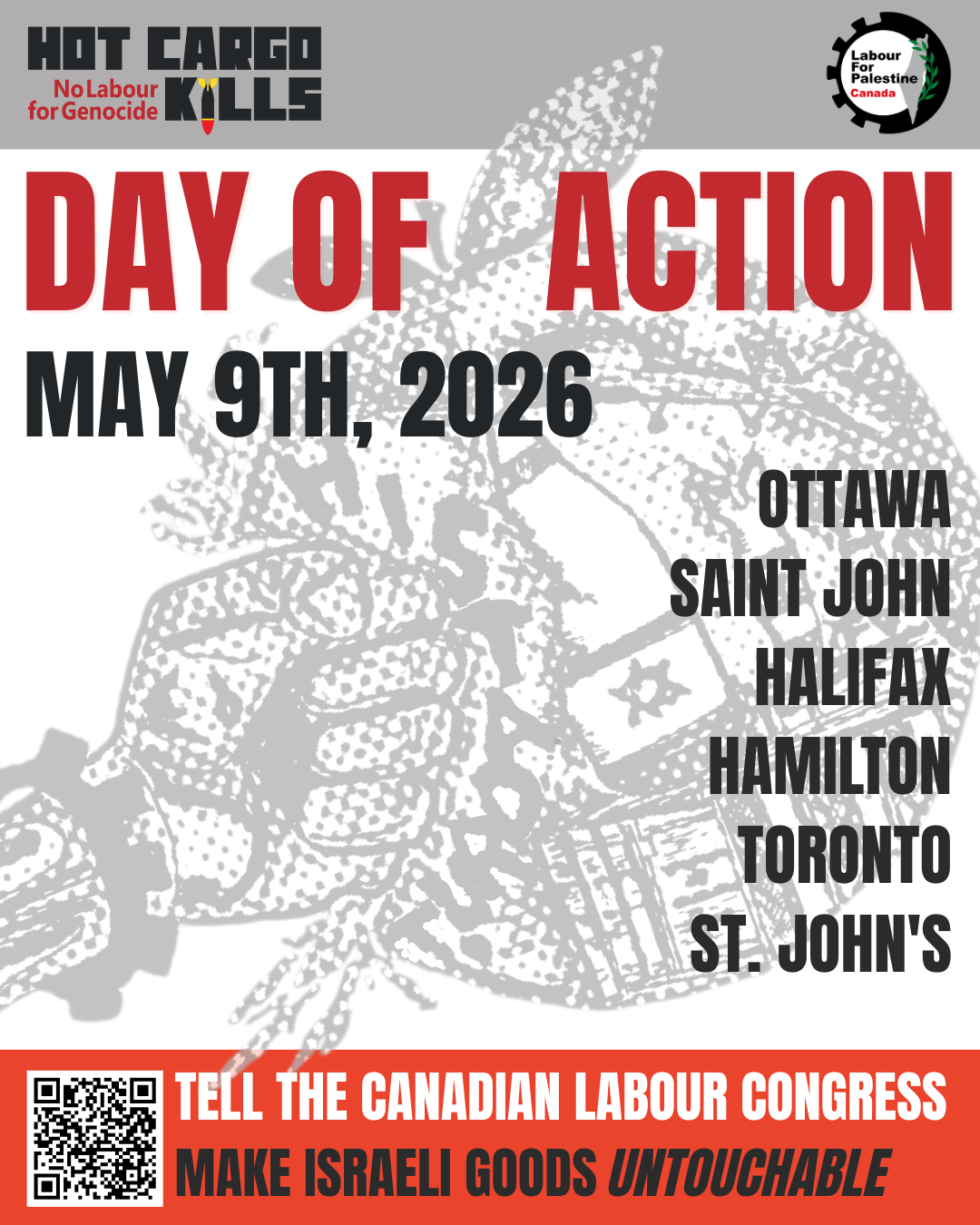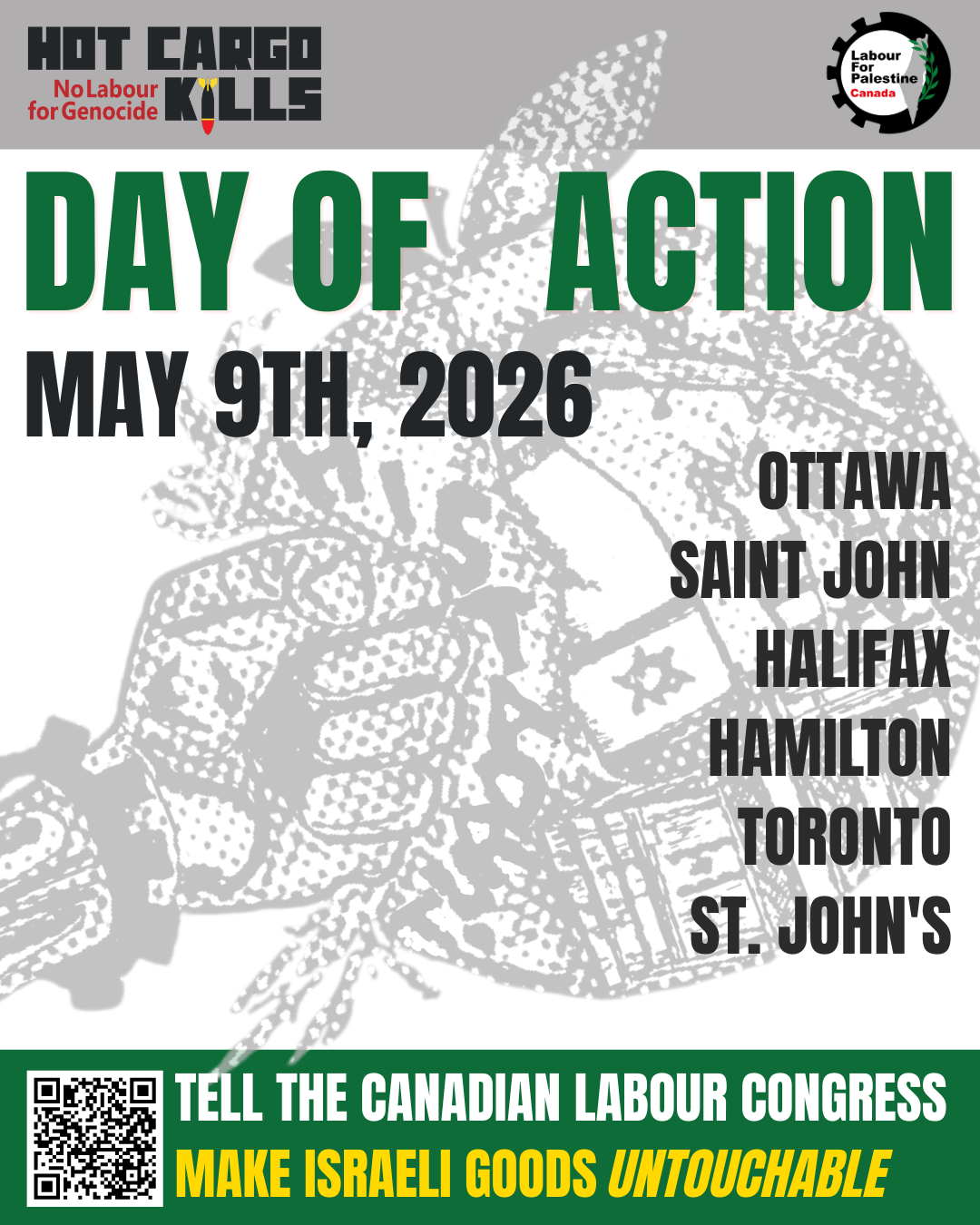

Palestinian trade unions are calling on YOU, our union siblings, to take action. They’ve asked the global labour movement to treat Israeli products, especially arms and military goods, as Hot Cargo.
Labour for Palestine chapters hosted local events from coast to coast as part of a Hot Cargo Kills National Day of Action on May 9, 2026. To get involved in Labour for Palestine, contact your nearest Labour for Palestine chapter or caucus.
Local events called on workers and the labour movement to apply Hot Cargo against the state of Israel, as well as key sites identified by local workers and demonstrate the power of worker-led refusal.
CONFIRMED EVENTS (ALL TIMES ARE LOCAL)
OTTAWA
What: Info Picket.
When: 1:30pm, May 9.
Where: LCBO at 275 Rideau St & King Edward.
SAINT JOHN
What: Open mic and art installation.
When: 12pm-3pm, May 9.
Where: Intifada Trail, Market Square (city hall).
HALIFAX
What: Info picket.
When: 11am-1pm, May 9.
Where: Pete's Frootique, 1515 Dresden Row.
VANCOUVER
What: Info picket.
When: 1pm, May 9.
Where: 1520 Commercial Drive.
TORONTO
What: Info picket.
When: 1pm, May 9.
Where: LCBO, Bloor and Bay.
HAMILTON
What: Info picket.
When: 10-11:30am, May 9.
Where: at the intersection of Sterling Street and Forsyth Ave North.
NANAIMO
What: Demo.
When: 2:30pm, May 16.
Where: Chapters, North Nanaimo.
WINNIPEG
What: Info picket.
When: 6pm-8pm, May 9.
Where: Osborne Liquor Mart (Osborne St, at River Ave).
VICTORIA
What: Info picket
When: 11am, May 9.
Where: Location TBA
ST. JOHN’S
What: Workers Assembly on Hot Cargo.
When: 2pm-4pm, May 9.
Where: The Hub (21 Merrymeeting Rd).
WHAT IS HOT CARGO?
It’s a labour tradition: workers refusing to handle goods and services linked to oppression, war, or strike breaking. It’s how we use our power on the job to show solidarity and disrupt injustice.
Unions have invoked the phrase of Hot Cargo to engage in work refusals or interruptions and to act in solidarity with international unions and workers during apartheid South Africa, dictatorships in Argentina and Indonesia / East Timor, and against the war on Iraq.
It’s time for unions and labour bodies to launch an international picket line against Israel, declaring all collaboration with Israel to be Hot Cargo, taking away Israel’s social license and laying the groundwork for a worker-led arms embargo.
HOT CARGO IS NOT JUST WEAPONS
Hot cargo, in the context of international politics, can sometimes be reduced in discussion to just the physical products of war production: weapons, munitions, vehicles, technology, and equipment. But we know that Israeli aggression against the Palestinians is made possible by more than just weapons.
Israeli settler-colonialism and apartheid is a social and economic project which promotes racial segregation, supremacy, and the occupation and genocide of indigenous Palestinian and the lands and resources.
But Hot Cargo is not just about military goods. It’s about all the goods, services and relations that may exist between Canadian institutions and institutions in Israel.
You don’t need to work at a munitions plant to be complicit in handling hot cargo. We need all sectors, private and public, to refuse to handle hot cargo in order to compel the CLC and the Government of Canada to act.
This might include formal agreements between institutions in the health sector, education, municipal government or the provincial or Federal governments. The procurement and use of AI technology is one example. Selling food and alcohol that is produced in Israel and the illegal settlements is another example.
RESOURCES / RESSOURCES
Day Of Action Poster
Hot Cargo Flyer | Cargaisons Meurtrieres Flyer
Hot Cargo presentation - what it is and what we can do.
Cut Ties with the Histadrut, 4-page flyer: Download Flyer to print | Télécharger le dépliant à imprimer